
New England outages are not hypothetical: nor’easters, ice storms and hurricanes take the grid down for days, not hours. A standby generator brings your home back in seconds and keeps it running as long as the fuel flows, automatically, whether you are home or not.
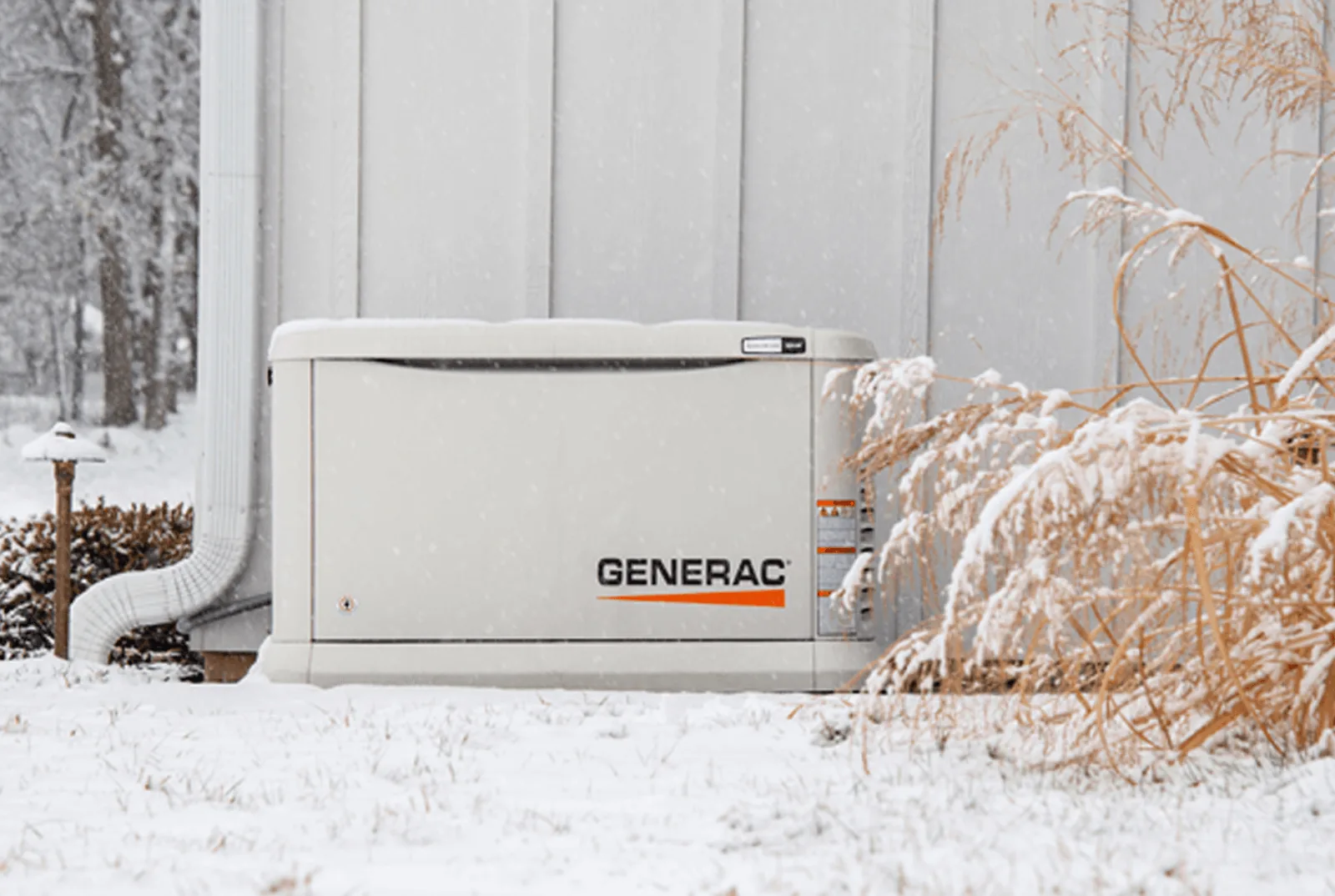
A standby generator sits outside your home like a central AC condenser, permanently wired into your electrical panel and plumbed to your natural gas line or a propane tank. It is not a portable unit you drag out of the garage and fill with gas cans. It lives outside, ready, and it runs on its own.
The piece that makes it automatic is the transfer switch. When the grid drops, the automatic transfer switch senses the loss of utility power, starts the generator, waits a few seconds for it to reach full speed, then transfers your circuits over to generator power. The whole handoff happens in seconds, usually before you have found a flashlight. When utility power returns, the switch hands your home back to the grid and shuts the generator down.
That transfer switch also does something critical for safety: it electrically isolates your home from the utility lines while the generator runs, so your power can never backfeed onto the grid and endanger a line worker restoring service. It is the difference between a code-compliant permanent installation and the extension-cord setups that put people in the hospital every storm season.
Because the unit is wired straight into your panel, there are no cords running through a cracked window, no swapping fuel in the dark, and no need to be home when the lights go out. You can be at work or asleep and the house takes care of itself.
The most common mistake in generator sizing is starting from the generator instead of from your house. We start from your loads. In a February ice storm in Rhode Island or Connecticut, the things that matter are heat, the well pump if you are on a well, the sump pump if you have a basement, refrigeration, and any medical equipment someone in the home depends on. Those are the circuits that turn a multi-day outage from dangerous into a non-event.
Heat is usually the biggest driver in New England. A gas or oil furnace still needs electricity to run its blower and controls, and a heat pump needs real power. If your basement floods without a sump pump, or your pipes freeze without heat, the generator is not a convenience, it is protecting the house itself. Well pumps draw a heavy surge when they start, and that starting load, not the running load, often decides the size of the unit.
From there we decide between whole-home coverage and an essential-circuits design. Whole-home coverage runs everything, so an extended outage feels like nothing changed. An essential-circuits design powers the loads that matter and skips the ones that do not, which lets a smaller, less expensive unit carry your home through the storm. Neither is automatically right. It depends on your home, your fuel supply, and what you want the outage to feel like.
We do an actual load calculation for your house rather than guessing from square footage. If a household member relies on oxygen, a CPAP, dialysis, or refrigerated medication, we tell you that plainly and design around keeping that equipment running without interruption.
A standby generator runs on one of two fuels, and which one is right comes down to what your property already has. If you have natural gas service, the generator ties into that line and you never refuel it. As long as the gas keeps flowing, which it typically does even during electrical outages, the generator runs for days without anyone touching it. For most homes with a gas line already at the house, this is the simplest answer.
If you do not have natural gas, propane is the workhorse. A propane standby generator draws from an on-site tank, and it works anywhere a tank fits, which covers most of the rural and coastal New England homes that do not have a gas main on the street. The tradeoff is that propane is a finite supply, so tank size determines how many days of runtime you have before a refill. We size the tank to the runtime you want, so a long nor’easter does not run you dry on day two.
Both fuels burn cleaner and store far better than the gasoline a portable generator needs, and neither requires you to stand in a storm pouring fuel. We coordinate the fuel side with the appropriate licensed gas fitter or propane supplier as part of the project, so the connection is done correctly and to code, not left for you to figure out afterward.
This is the honest question most homeowners are really asking, and the answer is that a generator and a battery solve different lengths of outage. A home battery is silent, kicks in instantly, powers your essentials cleanly, and recharges from your solar every day the sun is out. It is ideal for the short and frequent outages that make up most of what New England throws at you.
A standby generator is built for the events a battery is not sized for: the multi-day nor’easter, the ice storm that drops trees across the whole town, the hurricane aftermath that leaves the grid down for the better part of a week. It does not care how long the outage lasts, only that the fuel keeps flowing.
Homes that lose power often, or for long stretches, are frequently best served by both. The battery covers the first hours silently and seamlessly, the generator carries the long haul, and solar keeps the battery topped off in between and lowers the everyday bill regardless of the weather. We design the transfer scheme so all three work together safely instead of fighting each other.
We will tell you which setup fits your home based on your actual outage history, your loads, and your budget, not on whichever product carries the best margin that month. Sometimes the right answer is a battery and no generator. We will say so.
A standby generator is not a plug-in appliance. It involves serious electrical work at your panel, a properly rated automatic transfer switch, a fuel connection, a level pad or mounting base, and local permits and inspections in every RI, MA and CT town. Done wrong, it is a fire and carbon-monoxide risk. Done right, it is invisible until the day you need it.
Our licensed electricians handle the electrical scope: the transfer switch, the panel work, the load calculation, and the wiring, all to code. We coordinate the fuel connection with the appropriate licensed fitter, set the unit on its pad, and see the whole installation through inspection and commissioning so it is signed off and tested before we call it done.
Because Rooftop Power runs in-house crews rather than subcontracting the work out, one local company is accountable for the entire job. There is no finger-pointing between an electrician, a fuel installer, and a middleman when something needs attention. You call us, and the people who installed it are the people who answer.
The whole value of a standby generator is that it works the one day you need it, which is why what happens after the install matters as much as the install. A quality unit runs a weekly self-test on its own, cycling the engine for a few minutes so you know it will start, and it reports its status so a problem surfaces long before a storm, not during one.
Like any engine, a standby generator wants annual service: oil and filter, spark plugs, a battery check on the starter battery, and a load test to confirm it will carry your home under real demand. Skip that maintenance and the failure shows up at the worst possible moment, when the grid is already down and no service tech in the state is available.
Our local service team keeps your backup equipment ready year-round, which matters more than any number on a spec sheet the day the grid drops. Because we are local and we own the crews, we are the same people who put the unit in, so we already know your installation when you call.
We can bring the same service coverage to your solar and battery equipment, so your entire backup setup is maintained by one company that answers the phone in New England, not a call center for a manufacturer three time zones away.
We do not quote a single sticker price for standby generators because an honest number depends on your home, and anyone who gives you one over the phone is guessing. What we can do is tell you exactly what moves the price so there are no surprises when you see the written proposal.
The biggest driver is how much of your home you want to power. An essential-circuits design that carries heat, water, refrigeration, and a few key rooms needs a smaller, less expensive unit than a whole-home system that runs everything including central air. The size of the generator follows directly from that decision and the load calculation behind it.
The next factors are the electrical and fuel work at your specific house: how far the unit sits from your panel and your gas or propane supply, whether your existing panel and service can handle the transfer equipment or need an upgrade, the pad or base the unit sits on, and the permit and inspection requirements in your town. A home with the gas line and panel already in the right place installs for less than one that needs a service upgrade and a long fuel run.
We put all of it in writing before you commit: the unit, the transfer switch, the electrical and fuel scope, the permits, and the total, with the tradeoffs between whole-home and essential-circuit coverage laid out side by side. You decide with the real numbers in front of you, not a pressured guess.
If you already have solar, or you are considering it, a standby generator fits into a larger plan for keeping your home powered and your bill lower. Solar cuts what you pay the utility every single day the sun is out. A battery stores that solar so your essentials ride through the common short outages silently. A generator stands behind both for the rare multi-day event that outlasts a battery.
The pieces have to be designed to work together, though, or they interfere with each other. The transfer scheme has to sequence solar, battery, and generator so the generator does not fight the inverter and the battery charges correctly during an extended outage. This is exactly the kind of integration that goes wrong when three different contractors each install their own piece.
Because Rooftop Power installs solar, batteries, roofing, and standby generators with our own crews, we design the whole system as one job under one roof. Whether you start with a generator today and add solar later, or build the full resilient setup at once, the parts are engineered to fit, and one local company stands behind all of it.
Working with Rooftop Power has been exceptional. From the beginning everyone at RTP kept me informed at every step. When a hiccup happened it was addressed immediately and resolved.
The installation crew was punctual, respectful, and left the job site spotless. I was particularly impressed with their attention to detail from the first consult to the final inspection.
Had a great solar experience with Rooftop Power from start to finish. We ended up getting a new roof and electrical upgrade for the install and used RP for both.
A free backup assessment: your loads, your fuel options and the right design, in writing.